
J. G. Ballard, 1962
Nevers was switching on sculptures right and left like a lunatic magician, and the noise was a babel of competing sensocells, some of the statues responding to Lunora’s enigmatic presence, others to Nevers and the secretary
Lunora shook her head slowly, mouth hardening as the noise irritated her. “Yes, Mr. Nevers,” she said in her slightly husky voice, “it’s all very clever, but a bit of a headache. I live with my sculpture, I want something intimate and personal.”
“Of course, Miss Goalen,” Nevers agreed hurriedly, looking around desperately. As he knew only too well, sonic sculpture was now nearing the apogee of its abstract phase; twelve-tone blips and zooms were all that most statues emitted. No purely representational sound, responding to Lunora, for example, with a Mozart rondo or (better) a Webern quartet, had been built for ten years. I guessed that her early purchases were wearing out and that she was hunting the cheaper galleries in tourist haunts like Vermillion Sands in the hope of finding something designed for middle-brow consumption.
Lunora looked up pensively at Zero Orbit, towering at the rear of the gallery next to Nevers’s desk, apparently unaware I was hiding inside it. Suddenly realizing that the possibility of selling the statue had miraculously arisen, I crouched inside the trunk and started to breathe heavily, activating the senso-circuits.
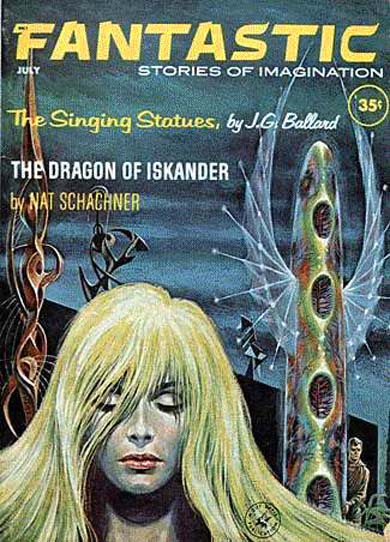
Immediately the statue came to life. About twelve fee high, it was shaped like an enormous metal totem topped with two heraldic wings. The microphones in the wing-tips were powerful enough to pick up respiratory noises at a distance of twenty feet. There were four people well within focus, and the statue began to emit a sweries of low rhythmic pulses.
Seeing the statue respond to her, Lunora came forwards with interest. Nevers backed away discreetly, taking Mme Charcot with him, leaving Lunora and I together, separated by a thin metal skin and three feet of vibrating air. Fumbling for some way of widening the responses, I eased up the control slides that lifted the volume. Neurophonics has never been my strong suit – I regard myself, in an old-fashioned way, as a sculptor, not an electrician – and the statue was only equipped to play back a simple sequence of chord variations on the sonic profile in focus.
Knowing that Lunora would soon realize that the statue’s repertory was too limited for her, I picked up the hand-make used for testing the circuits and on the spur of the moment began to croon the refrain from Creole Love Call. Reinterpreted by the sonic cores, and the relayed through the loudspeakers, the lulling rise and fall was pleasantly soothing, the electronic overtones disguising my voice and amplifying the tremors of emotion…