
(Carlos Salzedo, 1927)
What follows is a sort of definitive prologue from the point of view of a harpist-composer toward the “harp-to-be.” …the instrument should be a still more powerful one, every part should be made larger. Then, there must be a total transformation in order to bring about the realization of the “Harp Idea” – an instrument equivalent to the pipe organ, a Polyharp. This consists of seven giant harps built on a sonorous platform, each harp connected by a sonorous corridor at the most resonant part of the body. This “polyharp” would have to be built in a definite place in a room or concert hall – as is a pipe organ. One can easily imagine the extraordinary synthesis of sound of such an instrument; it would be like an harmonic bath. The superiority of the polyharp to the pipe organ will be due to the unstopped vibrations amplified, and still more to the interwoven harmonies through the sonorous corridor. This is not a mere fantasy. Perhaps a generation will pass before it can be realized, but this scheme is the normal evolution of the “Harp Idea.” Scientists and composers who are looking for new discoveries fully share this opinion. Far-sighted harpists also agree that this will be the inevitable transformation of the harp.
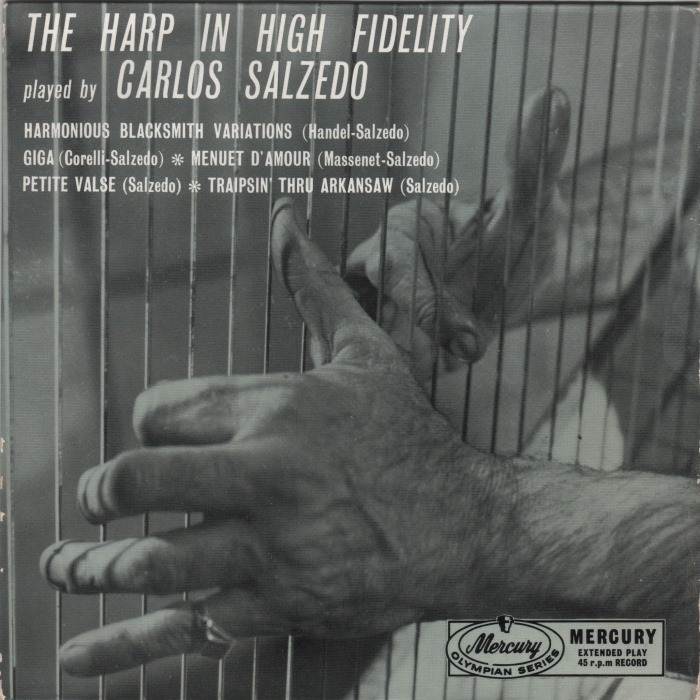
Carlos Salzedo (1885-1961) was a French harpist-composer who emigrated to the United States and in the 1920s became a leading advocate for new music (promoting work by contemporary composers) and for the harp (founding the National Harp Association). Both strands are evident in the 1927 essay in which he proposed the polyharp. Following the description of the “harp-to-be” excerpted above, he went on to explain that it was a common mistake to regard the harp as capable of only one tone color when in fact it could make thirty-seven, and that “the future of music rests with those, public and musicians, who will penetrate the essentialnesss of each instrument.” The polyharp he imagined as the harp’s natural, inevitable future extends the tradition of giganticism seen with instrument inventor Adolphe Sax and late nineteenth-century composers, and resonates with the modernist faith in technological and artistic advancement of the 1920s. Salzedo concluded his essay emphatically: “New harpism cannot instantly take the place of the inartistic and unharpistic harpism of yesteryear. We cannot annihilate those who are unwilling to understand, to admit, and to follow the musical trend of today; but they must not obstruct the normal evolution of the harp. They must not hinder. Life is already too short for the perfecting of ideals.” Though Salzedo did not live to see the polyharp realized, the high-fidelity recordings of his harp compositions released in the 1950s perhaps approximated his ideal of a “harmonic bath.”
Text: Carlos Salzedo, “The Newest of Musical Instruments – the Harp,” Papers and Proceedings of the Music Teachers’ National Association (1927), 64-75.
Image: The Harp in High Fidelity Played by Carlos Salzedo (1958), album cover
Thanks to harpist-historian Ina McCormack for bringing the polyharp to our attention.